Thursday, May 5, 2011
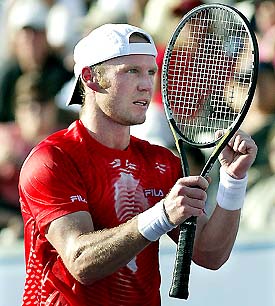
Peter Polansky Canadian professional tennis player
Wednesday, May 4, 2011
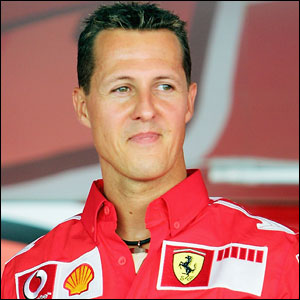
Michael Schumacher Early years Info & Latest Images
Schumacher was born in Hürth, North Rhine-Westphalia, West Germany,to Rolf Schumacher, a bricklayer, and his wife Elisabeth. When Schumacher was four, his father modified his pedal kart by adding a small motorcycle engine. When Schumacher crashed it into a lamp post in Kerpen, his parents took him to the karting track at Kerpen-Horrem, where he became the youngest member of the karting club. His father soon built him a kart from discarded parts and at the age of six Schumacher won his first club championship. To support his son's racing, Rolf Schumacher took on a second job renting and repairing karts, while his wife worked at the track's canteen. Nevertheless, when Schumacher needed a new engine costing 800 DM, his parents were unable to afford it; Michael was able to continue racing with support from local businessmen.
Regulations in Germany require a driver to be at least 14 years old to obtain a kart license. To get around this, Schumacher obtained a license in Luxembourg at the age of 12.
In 1983, he obtained his German license, a year after he won the German Junior Kart Championship. From 1984 on, Schumacher won many German and European kart championships. He joined Eurokart dealer Adolf Neubert in 1985 and by 1987 he was the German and European kart champion, then he quit school and began working as a mechanic. In 1988 he made his first step into single-seat car racing by participating in the German Formula Ford and Formula König series, winning the latter.
In 1989, Schumacher signed with Willi Weber's WTS Formula Three team. Funded by Weber, he competed in the German Formula 3 series, winning the title in 1990. At the end of 1990, along with his Formula 3 rivals Heinz-Harald Frentzen and Karl Wendlinger, he joined the Mercedes junior racing programme in the World Sports-Prototype Championship. This was unusual for a young driver: most of Schumacher's contemporaries would compete in Formula 3000 on the way to Formula One. However, Weber advised Schumacher that being exposed to professional press conferences and driving powerful cars in long distance races would help his career.[9] In the 1990 World Sportscar Championship season, Schumacher won the season finale at the Autódromo Hermanos Rodríguez in a Sauber–Mercedes C11, and finished fifth in the drivers' championship despite only driving in 3 of the 9 races. He continued with the team in the 1991 World Sportscar Championship season, winning again at the final race of the season at Autopolis in Japan with a Sauber–Mercedes-Benz C291, leading to a ninth place finish in the drivers championship. He also competed at Le Mans during that season, finishing 5th in a car shared with Karl Wendlinger and Fritz Kreutzpointner. In 1991, he competed in one race in the Japanese Formula 3000 Championship, finishing second.
Regulations in Germany require a driver to be at least 14 years old to obtain a kart license. To get around this, Schumacher obtained a license in Luxembourg at the age of 12.
In 1983, he obtained his German license, a year after he won the German Junior Kart Championship. From 1984 on, Schumacher won many German and European kart championships. He joined Eurokart dealer Adolf Neubert in 1985 and by 1987 he was the German and European kart champion, then he quit school and began working as a mechanic. In 1988 he made his first step into single-seat car racing by participating in the German Formula Ford and Formula König series, winning the latter.
In 1989, Schumacher signed with Willi Weber's WTS Formula Three team. Funded by Weber, he competed in the German Formula 3 series, winning the title in 1990. At the end of 1990, along with his Formula 3 rivals Heinz-Harald Frentzen and Karl Wendlinger, he joined the Mercedes junior racing programme in the World Sports-Prototype Championship. This was unusual for a young driver: most of Schumacher's contemporaries would compete in Formula 3000 on the way to Formula One. However, Weber advised Schumacher that being exposed to professional press conferences and driving powerful cars in long distance races would help his career.[9] In the 1990 World Sportscar Championship season, Schumacher won the season finale at the Autódromo Hermanos Rodríguez in a Sauber–Mercedes C11, and finished fifth in the drivers' championship despite only driving in 3 of the 9 races. He continued with the team in the 1991 World Sportscar Championship season, winning again at the final race of the season at Autopolis in Japan with a Sauber–Mercedes-Benz C291, leading to a ninth place finish in the drivers championship. He also competed at Le Mans during that season, finishing 5th in a car shared with Karl Wendlinger and Fritz Kreutzpointner. In 1991, he competed in one race in the Japanese Formula 3000 Championship, finishing second.
Wednesday, April 27, 2011
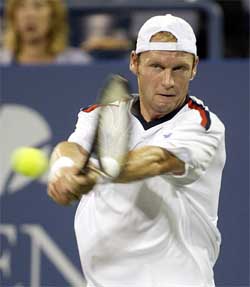
Rainer Schuettler Tennis Player
Saturday, April 23, 2011
maria sharapova hot
Sunday, April 17, 2011
Michael Phelps Mini Bio & Latest Foto
Michael Fred Phelps (born June 30, 1985) is an American swimmer who has, overall, won 16 Olympic medals—six gold and two bronze at Athens in 2004, and eight gold at Beijing in 2008, becoming the most successful athlete at both of these Olympic Games editions. In doing so he has twice equaled the record eight medals of any type at a single Olympics achieved by Soviet gymnast Alexander Dityatin at the 1980 Moscow Summer Games. His five golds in individual events tied the single Games record set by Eric Heiden in the 1980 Winter Olympics and equaled by Vitaly Scherbo at the 1992 Summer Games. Phelps holds the record for the most gold medals won in a single Olympics, his eight at the 2008 Beijing Games surpassed American swimmer Mark Spitz's seven-gold performance at Munich in 1972. Phelps' Olympic medal total is second only to the 18 Soviet gymnast Larissa Latynina won over three Olympics, including nine gold.
Phelps's international titles and record breaking performances have earned him the World Swimmer of the Year Award six times and American Swimmer of the Year Award eight times. He has won a total of fifty-nine medals in major international competition, fifty gold, seven silver, and two bronze spanning the Olympics, the World, and the Pan Pacific Championships. His unprecedented Olympic success in 2008 earned Phelps Sports Illustrated magazine's Sportsman of the Year award.
After the 2008 Summer Olympics, Phelps started the Michael Phelps Foundation, which focuses on growing the sport of swimming and promoting healthier lifestyles. As a participant in the US Anti-Doping Agency's "Project Believe" program, Phelps is regularly tested to ensure that his system is clean of performance-enhancing drugs.
Thursday, April 14, 2011
Anastasia Myskina Female Tennis Player
'She knows exactly how to coach kids. It's so hard to tell kids they have to do certain things, but she's really good at it. She understands children and she's a great person.'
In 1998, at the age of 17, Myskina broke into the Women's Tennis Association (WTA) top 500 and turned professional. On only her second main draw appearance in Palermo, Myskina won her first WTA title. Channelling her talent, she rapidly climbed the rankings to become one of the best baseline players in the world.
Since becoming professional Myskina has won a total of 10 WTA tour singles titles. In 2003 she fulfilled her dream of becoming the first Russian woman to win the Kremlin Cup in Moscow, Russia. The next year her career reached an all time high when she reached number 2 in the world rankings, and was named world champion by the International Tennis Federation. As well as successfully defending her Kremlin Cup title and representing Russia in the Olympic games in Athens, she also triumphed in the French Open. In a stunning series of victories, she knocked out Venus Williams in the quarter-final, Jennifer Capriati in the semis, and Elena Dementieva in the final. As she clinched the final point to claim the championship she couldn't quite believe she had won. On an all time high after the match, she was asked what it meant for her to win
Anastasia Myskina Female Tennis Player PhotosSunday, April 10, 2011
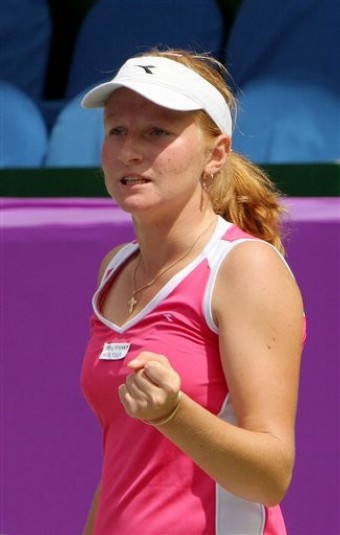
Alla Kudryavtseva biography pictures & wallpaper
Alla Alexandrovna Kudryavtseva (Russian А́лла Алекса́ндровна Кудря́вцева, born November 3, 1987 in Moscow) is a professional tennis player from Russia. She currently lives in Moscow, where she is coached by Nick Rybakov. Her father Alexander was a world champion Greco-Roman wrestler in the 1980s and her grandfather a Russian weightlifter of some note [1].
Her highest singles ranking as of October 4, 2010 World Number 56. Also on and as of June 26, 2007, her career-high doubles ranking is: World Number 73. As of June 14, 2010, Kudryavtseva is ranked World No. 85 at singles. Kudryavtseva has won $US952,589 in prize money, 1 singles title on the WTA tour, and 1 singles title and 6 doubles titles playing for the ITF. She was a finalist at the Orange Bowl Championships, as a junior.
Her main sponsor is Wilson and she also has an endorsement deal with Diadora.
Kudryavtseva's first Grand Slam tournament, competing in the main draw, was the 2007 Australian Open. She defeated Finland's Emma Laine in the first round 4–6, 6–2, 9–7, and then was defeated by her lifetime heroine, Martina Hingis, in straight sets, 6–2, 6–2 in the second round.
In 2007, Kudryavtseva defeated 29th seed Gisela Dulko 7–5, 1–6, 8–6 to reach the third round of Roland Garros, where she was defeated by second seed Maria Sharapova in straight sets 6–1, 6–4. After this match, she reached her new career high of #67.
At her first Wimbledon, in 2007, she lost against the eventual champion Venus Williams, 2–6, 6–3, 7–5.
During the 2008 Wimbledon, Kudryavtseva shocked the tennis world by beating fellow Russian and 3rd seed Maria Sharapova in the second round in straight sets 6–2 and 6–4. Afterwards, she joked "It's very pleasant to beat Maria... Why? Well, I don't like her outfit." (Sharapova wore a tuxedo-like outfit during the game .) She lost to Safina in the first round of the 2009 Australian Open.
At the 2009 Wimbledon Championships, she lost to #4 Elena Dementieva in the first round. And she lost at the second round of the Australian open 2010 of Agnieszka Radwańska with 6-0 and 6-2
In 2010, she reached the third round of the AEGON Classic in Birmingham, before losing to Maria Sharapova 6-3, 6-1.
She reached her first WTA final at the 2010 Guangzhou International Women's Open but lost to top seed Jarmila Groth 6-1, 6-4. Her good form continued and she won her first WTA singles title a week later, defeating Elena Vesnina 6-4, 6-4 at the 2010 Tashkent Open.
Alla Kudryavtseva great victory
Alla Kudryavtseva images
Alla Kudryavtseva pictures
Her highest singles ranking as of October 4, 2010 World Number 56. Also on and as of June 26, 2007, her career-high doubles ranking is: World Number 73. As of June 14, 2010, Kudryavtseva is ranked World No. 85 at singles. Kudryavtseva has won $US952,589 in prize money, 1 singles title on the WTA tour, and 1 singles title and 6 doubles titles playing for the ITF. She was a finalist at the Orange Bowl Championships, as a junior.
Her main sponsor is Wilson and she also has an endorsement deal with Diadora.
Kudryavtseva's first Grand Slam tournament, competing in the main draw, was the 2007 Australian Open. She defeated Finland's Emma Laine in the first round 4–6, 6–2, 9–7, and then was defeated by her lifetime heroine, Martina Hingis, in straight sets, 6–2, 6–2 in the second round.
In 2007, Kudryavtseva defeated 29th seed Gisela Dulko 7–5, 1–6, 8–6 to reach the third round of Roland Garros, where she was defeated by second seed Maria Sharapova in straight sets 6–1, 6–4. After this match, she reached her new career high of #67.
At her first Wimbledon, in 2007, she lost against the eventual champion Venus Williams, 2–6, 6–3, 7–5.
During the 2008 Wimbledon, Kudryavtseva shocked the tennis world by beating fellow Russian and 3rd seed Maria Sharapova in the second round in straight sets 6–2 and 6–4. Afterwards, she joked "It's very pleasant to beat Maria... Why? Well, I don't like her outfit." (Sharapova wore a tuxedo-like outfit during the game .) She lost to Safina in the first round of the 2009 Australian Open.
At the 2009 Wimbledon Championships, she lost to #4 Elena Dementieva in the first round. And she lost at the second round of the Australian open 2010 of Agnieszka Radwańska with 6-0 and 6-2
In 2010, she reached the third round of the AEGON Classic in Birmingham, before losing to Maria Sharapova 6-3, 6-1.
She reached her first WTA final at the 2010 Guangzhou International Women's Open but lost to top seed Jarmila Groth 6-1, 6-4. Her good form continued and she won her first WTA singles title a week later, defeating Elena Vesnina 6-4, 6-4 at the 2010 Tashkent Open.
Subscribe to:
Posts (Atom)